The “Landlord” Nightmare
Imagine you spend five years building a beautiful clothing boutique. You paint the walls, you fill it with expensive inventory, and you build a loyal customer base who visits every day.
But there is a catch: You signed a contract that says the landlord can lock you out at any moment, for any reason, without explanation.
One morning, you arrive at your shop, and the locks are changed. There is a note on the door: “You violated our terms. Goodbye.”
Your inventory is gone. Your customer list is gone. Your income is zero.
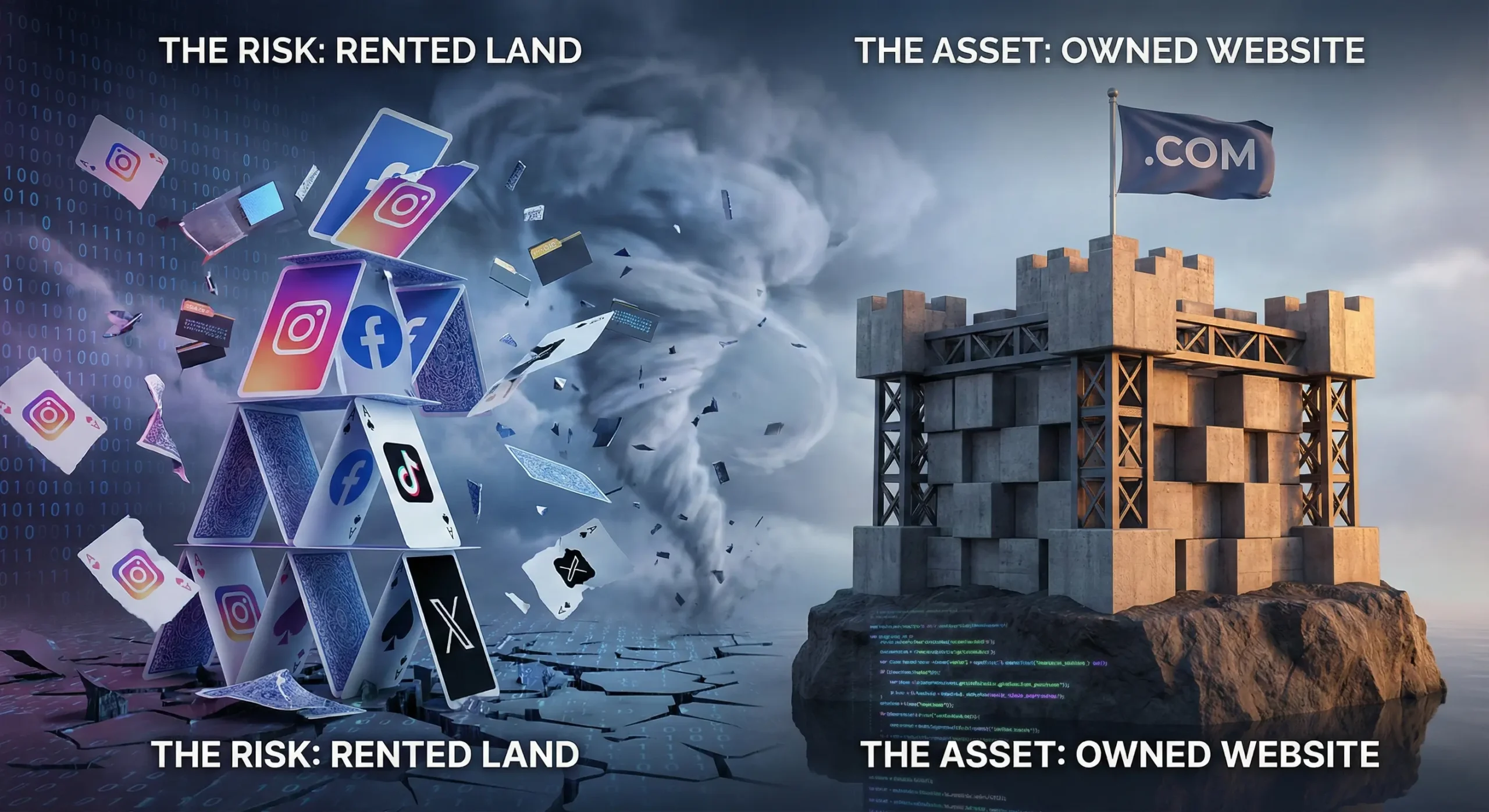
This sounds illegal in the physical world, but in the digital world, this happens every single day. If your business runs entirely on Instagram, Facebook, or TikTok, you are building business on rented land.
At Xiphos Webcraft, we believe you should be the owner of your success, not a tenant. Here is the deep-dive into the risks of relying on social media and why a website is the only true insurance policy.
1. The “Disabled Account” Panic
Search Twitter for “Instagram disabled my account for no reason,” and you will see thousands of business owners in panic mode.
AI moderation bots are aggressive. A competitor might report your post. You might accidentally use a copyrighted song. Or, the AI might just make a mistake.
The result is the same: Your business disappears instantly.
Without a Website: You have no way to contact your customers. You can’t tell them what happened. You are helpless.
With a Website: You simply post a notice on your homepage or email your list. Your “store” is still open, even if your “billboard” (social media) is down.
2. The Algorithm: Paying to Reach Your Own People
Remember when you used to post a photo and 50% of your followers saw it?
Today, you are lucky if 5% see it.
Social media platforms are public companies. They need to make money. Their strategy is simple:
Give you free reach to get you addicted.
Slowly kill the reach.
Force you to pay for ads to reach the people who already follow you.
This is one of the biggest risks of relying on social media. Your “followers” are not your customers; they are the platform’s users. The algorithm stands as a gatekeeper between you and your sales.
On your own website, there is no algorithm. If a customer types in your URL, they see your products. Period.
3. Valuation: You Can’t Sell an Instagram Page
Let’s talk about the future. Someday, you might want to sell your business and retire.
Investors and buyers look for assets.
An Instagram account is technically owned by Meta. Selling it is often against the Terms of Service and is very risky.
A website with a domain history, traffic data, and an email database is a sellable asset. It increases the valuation of your company.
By ignoring website vs social media ownership, you are pouring concrete into a foundation you don’t own. You are working hard to increase Mark Zuckerberg’s net worth, not just your own.
4. Data Ownership: Who Owns the Customer?
When you sell via DM or comments, you don’t really know your customer. You just know their handle, @cool_cat_99.
You don’t have their email. You don’t have their purchasing history organized.
Data is the new oil.
A website allows you to collect email addresses and build a database (CRM).
Scenario: Instagram shuts down tomorrow.
Website Owner: Sends an email blast to 5,000 customers: “Hey, follow us on our new platform!” Business continues.
Social-Only Owner: Loses everything.
Digital asset protection starts with owning your customer data. You cannot do that effectively on social media.
5. The “Professional” Ceiling
Finally, there is a limit to how much you can charge when you operate solely on social media.
High-ticket clients and B2B partners expect a website. If you send a proposal and your contact info is an Instagram link, they subconsciously devalue your service.
A website allows you to control the experience. No distractions, no competitor ads popping up next to your product, just your brand, your story, and your offer.
The Hub & Spoke Model
We aren’t saying you should delete your social media. We love social media! But it should be a marketing channel, not the entire business.
Think of your digital presence like a wheel:
The Hub: Your Website (Where the transaction happens, where the data is stored).
The Spokes: Instagram, LinkedIn, YouTube (Channels that drive traffic to the hub).
Stop renting your future.
Let Xiphos Webcraft build you a digital home that no one can take away from you.